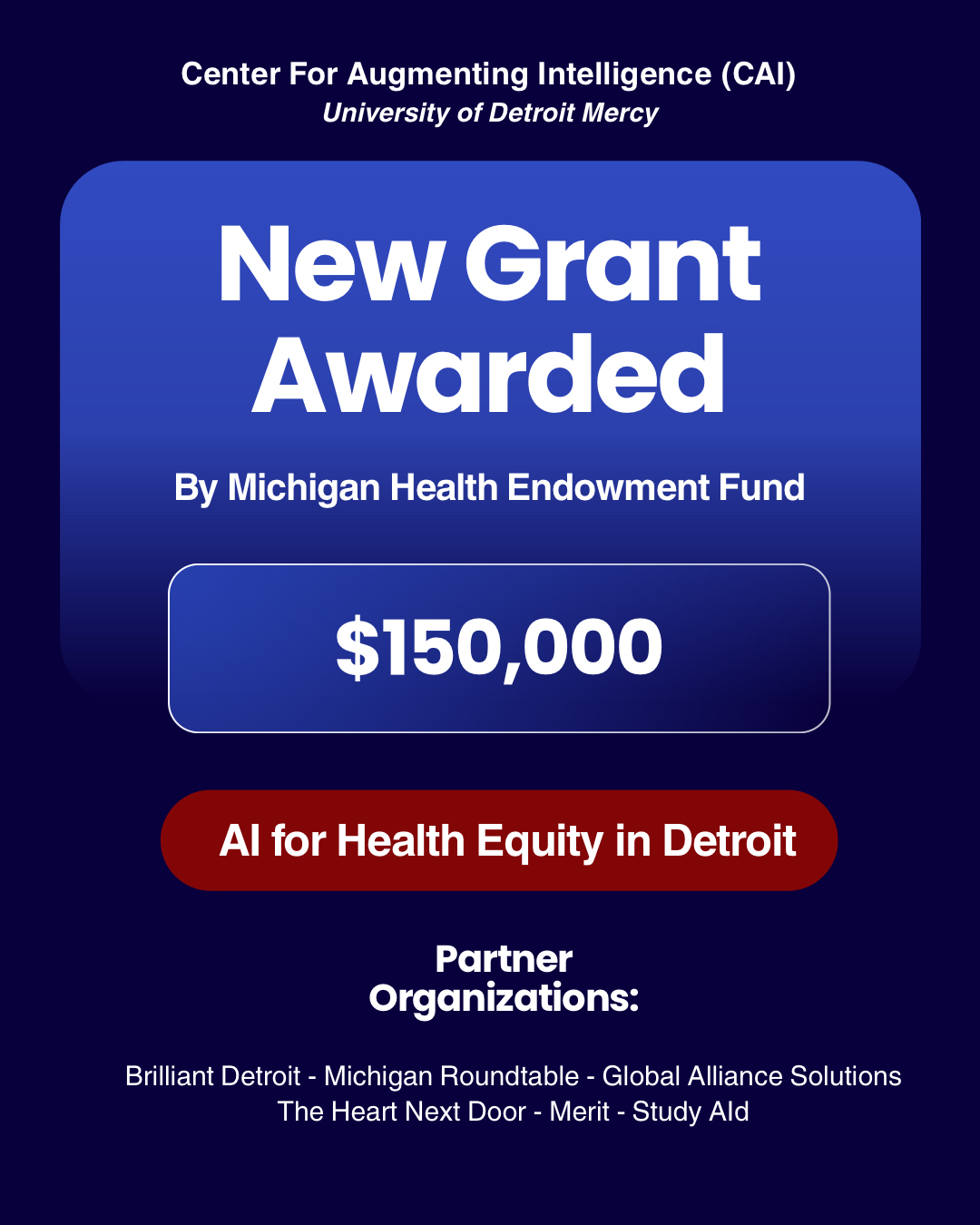
The Detroit AI Health Equity Collaborative, created by the Center for Augmenting Intelligence in Urban Health (CAI) at the University of Detroit Mercy, has been awarded a $150,000 Capacity Building Grant from the Michigan Health Endowment Fund.
This investment supports a bold, community-driven effort to ensure artificial intelligence (AI) improves, not widens, health outcomes for Detroit residents, particularly children, older adults, and families facing health disparities.
CAI is a multidisciplinary innovation and research hub dedicated to advancing human‑centered, ethical artificial intelligence to improve urban health outcomes and reduce health disparities. It brings together faculty, students, and community partners to co‑create AI solutions focused on education, applied research, and community‑driven innovation that strengthen decision‑making and promote equity in Detroit and similar urban communities.
What This Grant Makes Possible
Over the next 24 months, the Collaborative will bring together nonprofits, healthcare providers, digital equity leaders, and community organizations to:
- Build a shared AI governance model grounded in ethics, transparency, and community voice
- Design a Detroit AI Utility Model—a system that provides affordable, shared access to multiple AI tools through one platform
- Develop a health equity dashboard and evaluation framework to measure real-world impact
- Create a long-term sustainability plan to protect organizations from rising AI costs and vendor lock-in
This is a capacity-building initiative focused on planning and infrastructure, laying the groundwork for long-term impact across Detroit’s health ecosystem.
The Partners
Michigan Roundtable for Just Communities
Global Alliance Solutions Foundation
Addressing the “Low-Cost AI” Myth
Recent insights highlighted in the Low-Cost AI Illusion published by Stanford Social Innovation Review warn that while many AI tools appear free today, this is often temporary. As pricing models evolve, nonprofits risk facing rising and unpredictable costs, along with dependence on proprietary platforms.
The Detroit AI Health Equity Collaborative is designed as a direct solution to this challenge.
By creating a community-owned AI Utility Model, the Collaborative will:
- Pool demand across organizations to lower costs
- Establish shared governance to avoid vendor lock-in
- Vet tools for safety, ethics, and effectiveness
- Ensure long-term, sustainable access to AI resources
Rather than reacting to rising costs later, this initiative helps Detroit get ahead of the curve.
A Collaborative Approach to a Critical Moment
As AI rapidly transforms healthcare access, education, and social services, many community-based organizations are navigating these changes without shared infrastructure or guidance.
This initiative responds by building a community-governed, equity-centered AI ecosystem—ensuring organizations can safely and effectively use AI to:
- Improve health literacy
- Support care navigation
- Enhance service delivery
- Reduce disparities in access to information and care
The Collaborative model emphasizes shared decision-making, cross-sector coordination, and community voice, aligning with best practices for sustainable capacity building.
Why It Matters
Detroit is at a pivotal moment. While broadband access is expanding, true digital equity requires more than connectivity; it requires the ability to use technology safely, effectively, and affordably.
Without intentional action, AI could deepen existing inequities. With the right structure, it can become a powerful tool for community empowerment and health equity.
Leadership Perspective
“This grant allows us to bring organizations together to build something bigger than any one group could do alone, a shared, ethical AI infrastructure that puts community needs first. We’re not just adopting technology; we’re shaping how it serves our communities for the long term.”- Phillip Olla
Looking Ahead
By the end of the grant period, the Detroit AI Health Equity Collaborative will deliver:
- A complete AI Utility planning blueprint
- A shared evaluation and data framework
- A governance structure and partner agreements
- A sustainability and cost model for long-term impact
These outcomes will position Detroit as a national leader in equitable, community-driven AI adoption.