
In healthcare, policy decisions rarely show their consequences immediately. Funding shifts, regulatory changes, and new programs can take years to fully reveal their impact—often after resources have already been committed.
At the Center for Augmenting Intelligence (CAI), we believe universities have a responsibility to help decision-makers think more clearly about these futures before they unfold. This belief is what led us to explore superforecasting and to develop Oracolo™, an AI-assisted forecasting tool grounded in evidence-based reasoning.
What Is Superforecasting?
Superforecasting is a research-backed approach to making better predictions about real-world events by using structured reasoning, probability estimates, and continuous learning.
Rather than asking “Will this happen?”, superforecasting asks:
- How likely is this outcome?
- What assumptions are driving that likelihood?
- What new information would change our thinking?
This approach helps forecasters avoid overconfidence and encourages transparency in decision-making—skills that are essential in complex fields like healthcare and public policy.
The Good Judgment Project and the University Forecasting Challenge
Superforecasting emerged from the Good Judgment Project, a landmark research initiative that showed trained forecasters could consistently outperform intelligence professionals by using disciplined analytical methods.
Today, these methods are taught and tested through the University Forecasting Challenge, which brings together participants from dozens of universities and institutions worldwide. Students, faculty, and researchers forecast real-world questions across economics, technology, policy, and health, with accuracy measured using standardized scoring methods.
How Did Oracolo™ Perform?
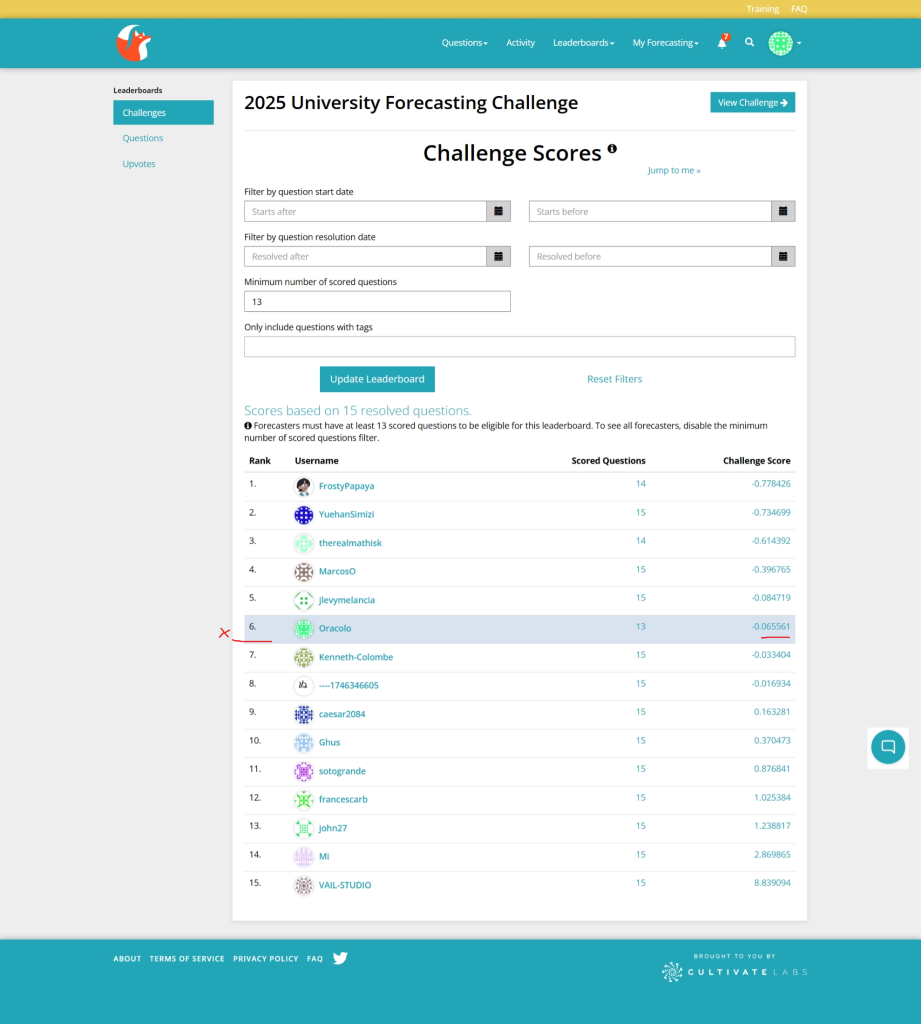
In the 2025 University Forecasting Challenge, Oracolo™ placed 6th overall among eligible participants.
- Scored Questions: 13
- Challenge Score: –0.0656
In superforecasting, lower (more negative) scores indicate better accuracy. Oracolo’s score reflects forecasts that closely matched real outcomes without extreme or overconfident predictions.
Importantly, Oracolo ranked ahead of many participants who answered more questions, demonstrating that quality of reasoning—not volume—drives forecasting success.
This result validates Oracolo’s underlying framework and confirms that structured, AI-assisted forecasting can meaningfully improve judgment.
Looking Ahead: Applying Forecasting to Health Policy and Funding Decisions
With Oracolo now validated in a competitive academic setting, CAI is expanding its use into areas where uncertainty has real human consequences—health policy, funding decisions, and equity-focused outcomes.
Health policies influence access to care, workforce stability, and community health long before their effects become visible. Oracolo allows us to explore these impacts in advance using probability-based reasoning.
A Detroit-Based Example
Consider Detroit’s ongoing investments in:
- community mental health services
- chronic disease prevention
- digital health and workforce development
Using Oracolo, we can forecast questions such as:
- How likely is a proposed state funding increase to reduce emergency department utilization in Detroit over the next two years?
- Will expanded support for community health workers improve preventive screening rates in specific Detroit neighborhoods?
- How might changes in Medicaid reimbursement affect safety-net providers serving urban populations?
These forecasts don’t replace policy decisions—but they inform them, highlighting risks, trade-offs, and likely outcomes before resources are committed.
Connecting Forecasting to the Sustainable Development Goals (SDGs)
Many health policy decisions are directly tied to progress on the United Nations Sustainable Development Goals, particularly:
- SDG 3: Good Health and Well-Being
- SDG 10: Reduced Inequalities
- SDG 11: Sustainable Cities and Communities
Oracolo can help forecast whether specific policy or funding changes are likely to advance—or unintentionally hinder—progress toward these goals. This is especially valuable for cities like Detroit, where targeted investments can have outsized impact.
Use Case Spotlight: Oracolo™ in Health Forecasting
Oracolo can be used to forecast:
- The likelihood that a new mental health policy improves access within underserved communities
- Whether changes in public health funding will meet SDG-aligned health targets
- How regulatory shifts may affect adoption of AI-driven care tools
- The probability that a pilot health program scales successfully across urban neighborhoods
Each forecast includes probability ranges, key assumptions, and scenario pathways—supporting smarter, more transparent decision-making.
Why This Matters for CAI
The University Forecasting Challenge showed that forecasting is a teachable skill and that AI can be used responsibly to support—not replace—human judgment.
At CAI, we are now leveraging Oracolo to:
- Support health policy analysis
- Inform funding and grant strategy
- Explore equity-driven health outcomes
- Train students and professionals to reason under uncertainty
As we expand into health-focused forecasting, Oracolo becomes a tool not just for prediction, but for better planning, better policy, and better outcomes.
For media inquiries or interviews, please contact the CAI Communications Team via the Contact Page.